Propaganda
18 August 2026
On Russel Hillier’s youtube channel in 2021, John van Zyl recounts his experiences serving in the Rhodesian Light Infantry in the 1970s:
And often these guys would open the conversation by calling the village headman. They would take the village headman... I’m sorry, I don’t know how graphic one can be on this... OK, you can always edit it out, right?... They’d cut off his lips and his nose and his ears, and then rape his wife in front of him, and then make his wife cook and eat her husband’s nose and ears and then bayonet him a hundred times in front of all the people, and then say to the village who now had been gathered round and are forced to watch all this happening, the village headman’s wife being raped and the village headman begin bayonetted to death and they’d say OK, we just want to show you guys that we mean business and we want you to provide us with food, we want you to provide us with beer, we want you to supply us with women, and you have to look after us, and you have to hide us. And if any of you report us to the security forces, we will put you inside your huts with your family and we will burn your hut, we will burn you alive.
So the villagers are now terrified. They were way more terrified of us than, I mean of the terrorists than they were of us, because we didn’t used to do that kind of thing, you know, so we’d come in and we’d ask for information. Yeah, we could be quite bossy and you know, shoving them around, trying to intimidate them, but they were not scared of us because they knew that we were not that barbaric and brutal.
To me, it seemed as though the indigenous Africans were just caught in the middle, they were caught in the middle. On the one hand you had these terrorists who were indoctrinated, and I don’t doubt that they believed strongly in the liberation, etc., but they were trained along classical Chinese communist methods of, that the first thing you do is you politicize the local population. And so they used to have these big meetings at night called pungwes where they would teach the people political slogans and try and educate them, try and politicize them basically because these people were just rural farmers. They had no political axe to grind at all.
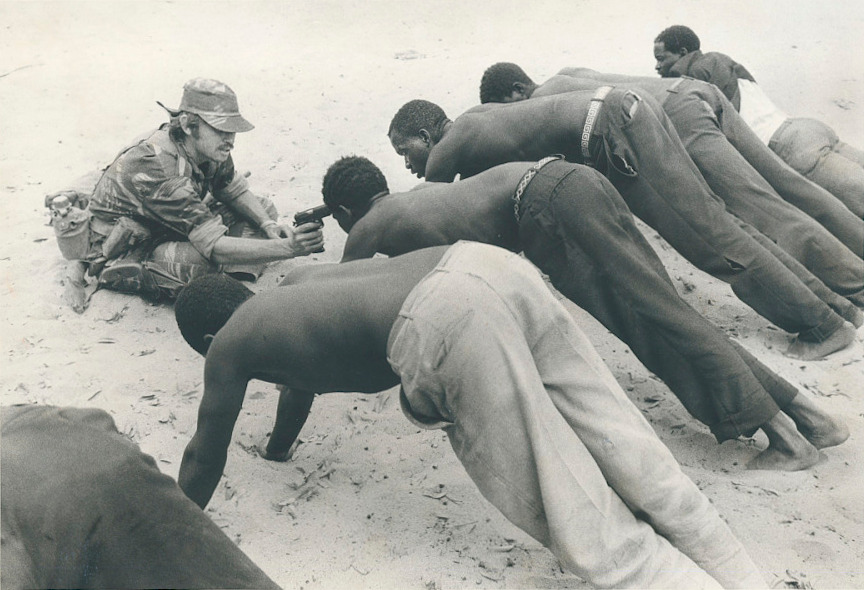
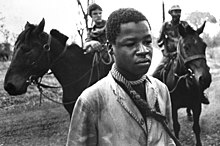
American photographer J. Ross Baughman went to Rhodesia in 1977 and spent two weeks embedded with Rhodesian security forces. This was enough to provide him with conclusive hard-hitting evidence proving what all right-thinking people the world over already knew: white supremacists were brutally oppressing Africans. Only two weeks after returning to the U.S. and publishing his findings, he won the Pulitzer Prize. His camera and original prints of the photos are now enshrined at the Smithsonian.
|
|
|
|
There was some controversy regarding the photos at the time, but only because Baughman had embedded with Rhodesian forces in the first place. Didn’t he know they were evil? Baughman defended himself:
I did not “infiltrate” or “join” the Rhodesian military... I arrived as a journalist, and all the soldiers knew that and treated me that way.
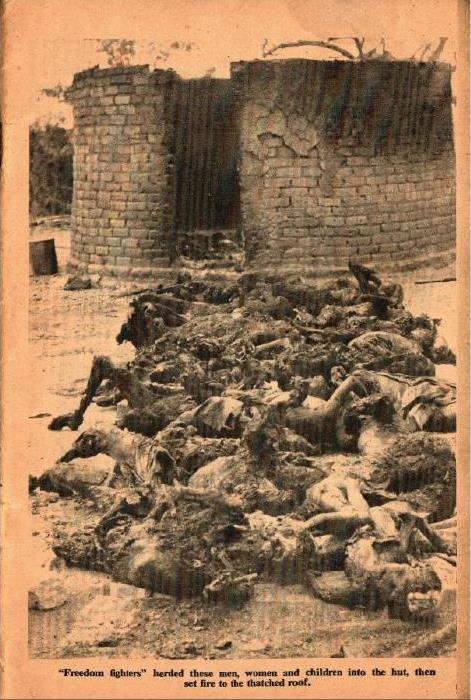
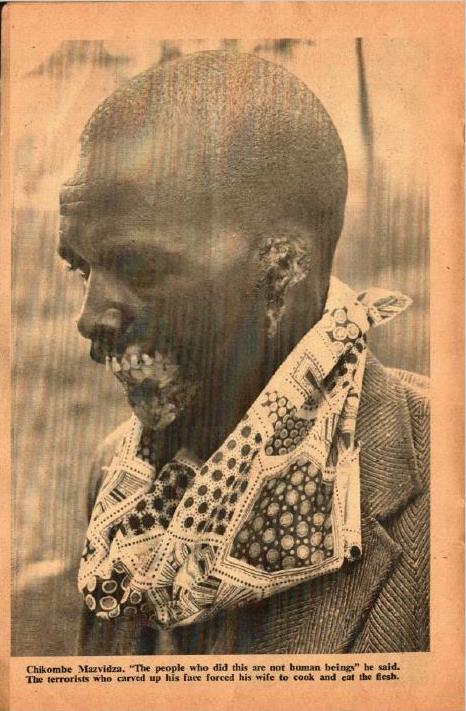
Of course, we don’t really know who the black men portrayed in Baughman’s photos are, what events had transpired before the picture was taken, or what harm actually befell these men at the hands of the security forces. We don’t even know if those men are bystanders, perps, or as has been alleged, black servicemen posing at Baughman’s request. One thing we can know for sure about them is that they did not end up like the villagers in the following photos taken by the Rhodesian government and distributed in a pamphlet titled Massacre of the Innocents in 1978. Mercifully, it seems headman Chikombe Mazvidza’s nose is intact and he was spared being bayonetted to death:
|
|
|
|
Of course, you can say these photos are fake or that the Rhodesians killed and mutilated people and blamed it on the communists. But if that is true, why haven’t the Information Office photos been propagated by anyone claiming evidence of Rhodesian wrongdoing? They have simply been ignored. And the point stands that Baughman’s photos won him instant acclaim and prizes even though they didn’t depict killing or mutilation. In fact, they were even more effective this way, because they played to western racial guilt and stereotypes in a way that horrific atrocities would not have. The images themselves fit perfectly into the western psyche regardless of anything else concerning the reality behind them.
This is also why the government photos were always dismissed out of hand. They ran against the same western stereotypes. Everything the government said in its own defense would be rejected and nothing that portrayed the guerillas in a negative light could be accepted no matter how true any of it was.
The point also stands that the government wanted journalists to embed with their forces. This doesn’t prove they did no wrong, but it proves they believed that a closer view of the situation in the TTLs would draw sympathy to their plight and expose the evils perpetrated by the guerillas. And western journalists were happy to use this access for their own ends.
No western journalist ever embedded with ZIPRA or ZANLA. That might actually have been dangerous. And everybody knew there was no Pulitzer Prize to be had from anything that might be seen there.